Showing posts with label authors. Show all posts

Friday, January 6, 2012

A Break Until Spring

So, my friends, my new year didn't stumble in tipsily, nor did it gently knock. It shattered my front door as sure as Vader blasted Alderaan. It has my full attention.

I must bow out (again!) of the blogging in order to do the living. It's a new living, and a challenging one: learning how to be a single mom, learning how to bid farewell to a love that leaves . . . as well as just lots of learning as I take four college courses while teaching part-time.

I know I disappeared last year, too. It's totally fair if you're not around when I come back. BUT! I'll come back in April. AND, I will offer you one of the BEST parting gifts!

My parting gift is the name and face of a new favorite: PATRICK ROTHFUSS


Back story: Laini herself first told Jen and me about Patrick Rothfuss when we met her in Chicago. Hearing we were from Wisconsin, Laini mentioned a great fantasty writer from Steven's Point. Okay, ANYBODY Laini recommends, I need to read. Unfortunately, I quickly forgot his name. Ack! But how can you blame me? I had just met Laini Taylor.

In December, Laini posted a picture of the back of her UK edition of DoSaB, and Rothfuss wrote the blurb on it: "Wow. I wish I had written this book." I thought, He blurbed her? How fantastic is that? And oh, yes, that's how you spell his name?

So I checked out his book, The Name of the Wind:
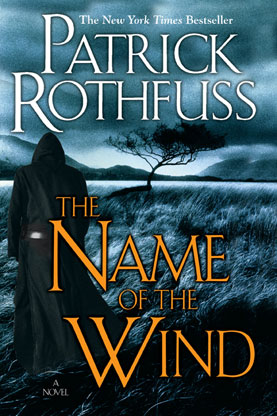

And friends, it's gorgeous. It's 700 pages of oh-my-god-he's-three-years-older-than-I-and-how-the-heck-did-he-get-so-amazing?-and-he-lives-an-hour-away!-and-I-want-to-eat-ramen-with-him-and-his-girlfriend-and-learn-everything-he's-ever-thought.

Wait, that was way too much inner dialogue.

It is, honestly, a beautifully-written tale of a young hero named Kvothe. Kvothe is a boy traveling with his troupe-family when disaster strikes. He struggles to survive for years before finding haven at the University. There he learns the magic of sympathy, but what knowledge he really seeks is a) how to call the name of the wind and b) how to find and conquer the baddies that attacked his troupe. Kvothe is a brilliant boy living in a ruthless world. Honestly, Kvothe is teaching me to take my licks these days better than any creed or self-help book. The boy gets knocked down every other page, it seems. But I'll be damned if he doesn't get back up every single time.

Check out Rothfuss' webpage and blog to learn more. (His blog Worldbuilders has raised over half a million dollars for Heifer International over the last several years. How fantastic is that?) And maybe, if you fall in love with the beard as much I do, watch a video or two of him to hear some of his thoughts of genre writing, Simon and Garfunkel, and trying to make the world a better place.

Rothfuss is coming to Appleton in April for our spring book festival. I'll be sure to return then with a post on his visit. Hopefully a couple of you will have joined Kvothe in his battle against the scrael and have enjoyed his captivating lute playing at the Eolian in Imre. :)

Keep writing. Keep hoping.

I'll talk to you soon.


Saturday, December 10, 2011

Geeking Out Over Collaborations


My love for both John Green and M. T. Anderson has led me to another dated discovery:

The hot-hot-hot themed YA anthology!

Collections of short stories by rockin' authors are popping up all over, and again I'm late to the party. But that's okay! Late to a party equals awesome! (NOT early. NOT on time. These, to a party, are not so awesome. These are tragic and send a gal home by 8:30 in tears.)

FIRST anthology is Gothic! Ten Original Dark Tales published by Candlewick in August 2004. I'm putting this first even though I have no real idea if it has a predecessor. If you know of another first, let me know! This cool collection came out with authors like Neil Gaiman, Celia Rees, Gregory Maguire, and of course, M. T. Anderson. (no. not obsessed.)

SECOND anthology is Geektastic: Stories from the Nerd Herd, published by Little, Brown in August 2009. Holly Black collected stories along with her friend and co-ComiCon attendee, Cecil Castellucci. Contributing authors include M. T. and John Green, natch, as well as Sara Zarr, Cassandra Clare, David Levithan, Cynthia Leitich Smith, Scott Westerfeld, Garth Nix, and Libba Bray.

Side-note: I ADORE 2009-LIBBA BRAY. I'm sure 2011-Libba Bray is just-as-if not-more adorable, but 2009-Libba Bray made this video promoting her Printz-winner, Going Bovine. Please watch, even if you never click on links. Three minutes of adorable in a cow costume.

I admit it: this is why I write. Not to write, but to write with friends like Libba who rock cow costumes in New York City. More on this thought in a second.

THIRD anthology is Zombies vs. Unicorns, collected again by Holly Black, this one published by Margaret K. McElderry Books in September 2010. This collection offers six stories pro-unicorns, and six stories pro-zombies. Contributing authors include Carrie Ryan, Maureen Johnson, Meg Cabot, and more fun from Cassandra Clare, Garth Nix, Scott Westerfeld, and Libba Bray.

John Green posted a vlog about this debate in 2007 and described unicorns as the "horned beasts of suck." Also, he questions, "What have unicorns ever accomplished? Providing transport for the Care Bears to and from the Forest of Feelings?" :)

LATEST collection is Steampunk!: An Anthology of Fantastically Rich and Strange Stories. This one came out by Candlewick in October 2011. It was put together by Kelly Link, but Holly Black still contributes, along with Corey Doctorow, M. T., Garth Nix, Cassandra Clare, and Libba Bray.

(Afterthought disclamier: This list of four books is, of course, in no way exhaustive and is as extensive as my Googling skills allow.)

So--I want to say how awesome I think this is--writers consistently publishing together.

I mean, I'm not saying that all these writers got together and wrote their stories in one big house, sharing coffee duties and pizza runs. However, clearly the community--as John said in his vlog--had been discussing the topics for months. I don't know, but I imagine that the books came out of those discussions. So community created art, rather than art bringing together a community.

I love that.

But, as an extension of that thought, why not gather together in a big house and write? Why can't we do that? Percy Shelley did, at Leigh Hunt's, with John Keats. Some writers used to write together. Some said--Shelley certainly said--they needed the companionship for inspiration. So I say YAY anthologies! YAY communities of writers collaborating and inspiring one another. I cannot WAIT to join you. I will totally take the first pizza run.

So my friends, who would you want in your big writers' house? Who would be in charge of meals? Who would you borrow toothpaste from? :) Who would you love to toss ideas around with over slices of pepperoni pizza?

Monday, November 14, 2011

Rockin' Jan Brett Rolls to Green Bay!

Jan Brett is touring from Boston to Walla Walla, driving across the country in an enormous, illustrated bus! Clara and I passed the bus as we drove to Green Bay on Sunday, November 13. I cheered and clapped and waved, so happy to see it on Highway 172! Clara kept asking, "What's wrong, Mom? What's wrong?" I tried to explain that a beautiful artist and storyteller was near, and that brought Mom so much joy. :)

Jan Brett spoke to a crowded room at the Brown County Central Library last night at 5:00 p.m. She shared with us the inspiration for her newest book, Home for Christmas. She also told us about the tour that she and her husband took of Sweden, doing research for the illustrations in the book. Since a moose is a key character in the story, she took the time to actually draw the head of a moose for us.


All the while, she was sharing charming anecdotes, like how she met a friendly herd of moose, and how she got to kiss one on its big, blubbery nose.


She filled her half-hour presentation with encouragement for all the young writers and artists in the auditorium. She reminded everyone that just as our fingerprints are our own, so our stories are our own. We have unique vision and creativity, she said. It is important not to lose our vision as we grow so we can make both ourselves and others happy with our art.

I was in line for over two hours to meet Jan. She is, without question, a rock star. Her website states that she has over 37 million books in print. Her stories are rich, warm, and deep. I grew up with "The Mitten," and Clara is daily enchanted by "The Owl and the Pussycat." Which of her books did you grow up with? What are you reading to the children in your life?


I know we are all trying to be true to our visions; but on the drive home, I thought about all of our unique stories. Not the ones we make up, but the ones we are living. And I wondered, what artist would you choose to illustrate the story of your life?


Tuesday, November 8, 2011

NaNoWriMo Check-in 1

Seven days of writing have passed. How’d I do?

Total word count: 7355

Total I should have if shooting for 1667 a day: 11669

SO--

I present to you four frank reasons I’m not stressing about being behind:

#1:


Kate DiCamillo!

My copy of The Chronicles of Harris Burdick came in, and I have a NEW literary crush to add to my list of crushes. Kate DiCamillo’s contribution to this collection is knock-you-in-the-teeth poignant and hilarious. Love, love, love the Kate! How can one be gloomy when Kate’s “The Third-Floor Bedroom” exists?

#2

I found Elzabeth Fama’s blog last night (and commented on it ;)). She, a published author, speaks candidly of the pros and cons (and many more cons) of our yearly NaNo competition. I love her honesty. Her reminder that our goals this month are sort of ridiculous helps me laughingly accept that I may not make my goals—but the best goal is to write every day.

How haunting is Elizabeth's cover?


#3


I’m writing. This, all by itself, is just lovely. This *poofs* stressful thoughts of more and now and hurry away.


My idea that I’m fleshing out this November I had in February, but I didn’t get to it. I had too many shows to watch. :) Then in April, I heard editor Julie Scheina--one of two editors who brought us Beautiful Creatures--speak at an SCBWI luncheon. She enthusiastically shared one of her new books coming:


Jane, by April Lindner, is a modern retelling of Jane Eyre.


My story idea is a modern retelling, too! So I should have been writing in April! Retells are wanted by editors, she said! But I didn’t go for it. I had too many naps to take. I dipped into it a teensey bit, enough to say I was working on it, but that’s about it.


Our NaNo has me deep in my story each night. I’m loving the characters. I’m loving the places they take me. I’m loving the cashmere sweaters or silver nail polish I find them wearing. I’m writing, and it’s fun.

#4

I am, let's repeat, doing a retelling. This makes my life easier, yes? I'd argue yes, absolutely, it does. In addition to my six pages of notes, I have the hundreds of pages of story to follow. So when Elizabeth Fama points out that October should be novel-planning month and we should create pages of detailed outline with dialogue notes—I mean, I do, right? I have the whole book in front of me. I read it again in October and wrote out character notes and plot points to emphasize, but . . . Come on. I think having an already-written-masterpiece in my hands takes some of stress away. :)

So that's my reports, my friends! How are you doing? Week 2, here we come! :)

Saturday, November 5, 2011

Harris Burdick Lives!


Joy, Joy, so much Joy!

So, for Chris Van Allsburg fans, the nearly unthinkable has happened. New stories have been written for the collection of enigmatic illustrations in his 1984 book, The Mysteries of Harris Burdick.

Just released October 25th is AN AMAZING COLLECTION of 14 stories inspired by the original artwork. The list of contributing authors is stunning. Inside we will find works by

Sherman Alexie
Kate DiCamillo
Cory Doctorow
Stephen King
Lois Lowry
Gregory Maguire
Walter Dean Myers
M. T. Anderson
and more!

Check out this hilarious clip that shows some of the authors and the pictures they chose to write about.

Can you stand it? Are you running to the bookstore now? Wait! While you're there, check to see if Chris Van Allsburg is coming to talk about this new release. Because I discovered he and beautiful M. T. will be in Chicago on November 17. Check it out!

And cross your fingers that my lovely, giving, self-sacrificing, wonderful, gorgeous sister will help me drive down there to see them. (Talented, hilarious, kind, creative, generous sister. . . )

So my friends, whose story are you looking forward to reading the most? Which picture from the original are you the most curious about?

Thursday, November 3, 2011

Author Steven Polansky Speaks at the Academy

I teach at an international academy in Northeast Wisconsin. Parents pop in often; we have moms who visit classes, dads who eat lunch with their daughters . . . imagine my surprise and delight learning that the attentive dad who joins his girl so very often in the cafeteria is Steven Polansky, author of Dating Miss Universe


and


The Bradbury Report


(Aw, man, trouble getting the cover to post . . . )


The first book is a collection of short stories that shows the failings of humanity with humor and grace. The second book is a novel that explores what it means to be human in 2071 when cloning is legal and "Copies" are used only for the aid of the "Original." Totally fascinating! And Steven totally needed to speak to our students! How is it possible we had not plundered all of his knowledge already? What riches to mine! :)


He graciously agreed to join us for an hour this week, kicking off our NaNo WriMo with an honest, in-depth discussion of the business of writing.


My hand flew as he spoke because quite literally every sentence he shared was either poignant or hilarious or ridiculously insightful or tremendously useful to us as writers. Ten pages of scrawl have been typed into four pages of notes. Here, I'd like to reproduce the gems I think will help us as we continue living our dreams as writers.


1. The world of publishing will be so changed in three years that in 2015, our students will know more about it than he. The institutions he knows--agents, editors, and printing companies--are being replaced, rendering all his years' experience in publishing obselete. (How fascinating and sobering is that?)


2. Consider the length of your novel. Length is gift we can offer our readers. He compared a small piece of writing to the passing glance of a beautiful face in mass-transit. One can fall in love in a moment like that, but the love doesn't linger. Contrast that passing glance with a deep, devoted marriage, and one will better comprehend the sense of knowing we experience reading a long novel. He said, leaving a world long lived in (he mentioned Harry Potter as a popular example), "The feeling is you are now transported back into your universe, and it is utterly transformed."


3. The life of a writer can be "the best of lives and the worst of lives." He confessed every morning starts the same. He faces his blank screen, and his inner critic tells him, 'Everything you've done before makes no difference. You have no idea how to do this next scene. You can't do it.' And it's awful. But then writes one sentence, and then two, then four, and he eventually forgets he can't do it


4. He gets his ideas for stories by keeping open. He watches and listens. He refuses to play the market research game, sniffing out what sells. Also, he refuses to keep a notebook to jot ideas into because 1) he'd never look at it, and 2) he'd forget what his notes meant if he did look at it. Instead, he just pays attention to those ideas that don't go away. If an idea stays in his head for three or four weeks, then he knows it's worth taking seriously. (Where do you get your ideas from?)


5. It takes him three years to write a novel. He wished those of us trying to do it in a month the best of luck. :) Rather than blasting through a zero draft as most of us have (or are), he methodically focuses on each chapter, perfecting it and then completely leaving it. He sites Dickens as a model for this style of writing: when a chapter of Dickens' Great Expectations was printed in the paper, thousands of readers made the events in that chapter indelible. Dickens couldn't go back and change things. Steven showed us some eighty pages of notes for one chapter of his current novel. (Again, how fascinating is this? I have six pages of notes! For the whole thing!)


6. He left us with two final thoughts:


If you truly want to be a writer, you should write. And there is no substitute for writing.


If you truly want to be a writer, you should read. And there is no substitue for reading.


My heartfelt thanks to Steven Polansky for sharing his wit and wisdom with us. I very much hope he will join us again soon!


So my friends, what do you think of his writing process? In the dawn of NaNos, is it worth reconsidering our methods?

Wednesday, October 26, 2011

M. T. Anderson Charms Sheboygan

Beautiful lake-side Sheboygan hosted its second annual Children’s Book Festival on October 14-16. I drove 90 minutes east on Saturday, October 15, to join 3 dozen teens and adults listen to Matthew Tobin Anderson speak on the mythology of American landscape.

We gathered at 1:00 at Sheboygan’s Mead Public Library. It’s a wide-windowed library, one clearly well-loved and well-funded. The third floor holds the children’s library as well as the Maas Teen Learning Center, a long conference-like room wrapped in aqua and cobalt blue. I studied the orange, green, and maize squares of the carpet while eavesdropping as a volunteer encouraged Anderson to order something to eat between sessions. He responded with gentle embarrassment, asking her often “Really?” and then joking of needing a filet mignon, medium-rare.

His voice, by the way, is as rich as James Spader’s. Think Steff in “Pretty in Pink.” Yet he’s funny and disarming. My god, it’s like he’s Duckie and Steff rolled into one—how’s a girl to learn anything when confronted with such a package? Especially when the package is wearing salmon-colored All Stars.

He began his 30-minute talk, and I did my best to pay attention. I was distracted by visions of my parents NOT having moved from Massachusetts when I was a baby. Then Anderson and I could have been next-door neighbors. We could have biked to the Carnegie-era brick library together and whispered among the pages of Conan the Barbarian, writing fake names in the yellowed check-out cards.

Clearly, I’m crushing on the M. T. Where is his fan page? I looked. Couldn’t find one. Seriously? No one is tracking his tours? What he had for lunch? (It was a ham sandwich.) Come on, cyber world. Start obsessing about quality, will you? There’s quality here, wearing pinkly-orange Chucks.

Okay—back to the conference room. Anderson began with a humble note that he’d had only one connection to Wisconsin—he had met our Butter Queen at a friend’s wedding. “I had expected her to be a greasier, more gelatinous creature,” he quipped, “but she was quite a lovely person.”

Landscape was his topic—our own rugged, revised American landscape. His devotion to landscape developed as a child reading adventure stories and histories that recorded folks doing on paper what largely is lost in the lives of the modern American: discovering vast, howling wildernesses. He was enraptured by the romance of geography and the mood of space.

How right and yet how surprising for me to consider America full of romance and mood. I fall into the spell—as he notes many writers do—of the magic of medieval Europe, of its henges and moors, its castles and lochs. But America is rich with its own witchery and lore. To that end, Anderson makes a point of collecting local ghost stories. Not only do they detail new, often private locations, but they poignantly display what he describes as the poetry of American emptiness—that loneliness that comes with night time walks in wide meadows and deep forests. The tellers of these tales, he says, are often more entertaining than the ghosts, themselves.

I have learned that author Linda Godfrey collected Wisconsin’s monster stories and is sharing them at the Neenah Library in a couple of weeks. My middle schoolers and I will be in the front row. How perfect an opportunity to experience local ghost stories with newly-opened minds. We will hear not only about UFO sightings and haunted locales, but we will hopefully see the landscape of our own state unfold ornately before us.

His presentation included layers of tales about a small settlement named Dog Town in Massachusetts. I suppose it would be rude for me to reproduce his notes, right? In brief, he showed pictures of the current location and told stories of the town from the 17th, 18th, 19th, and 20th centuries. The stories built up: what did happen, what happened in reaction to what happened, what happened on top of that, and then Anderson’s own jokey bits added on top of that—all of the area’s history of sadness, all of the magic of human involvement and connection, and all of the loneliness of the trees and boulders that carry centuries of secrets—these things together build landscape.

Landscape should be a more emotionally potent force in our stories than even our characters.

Now are we all in love? Because we should be. A Harvard-educated, National Book Award-winning author just shared brilliant stuff that will change our books forever, and he did it with generosity of spirit and maybe even a twinkle in his eye.

During Q & A time, an enthusiastic teen asked how in the world Anderson wrote in such varying voices. Particularly, Whales on Stilts contrasts with the sober tone of The Astonishing Life of Octavian Nothing. Anderson revealed that he actually wrote those books simultaneously. Researching his 18th century story thrust him deep into that odd, stylized, gracious tone that referred to breeches, not pants, and required specific buckles on each shoe. Giving himself a holiday, he created the Pals in Peril series. Taking three or four weeks to write Whales on Stilts, he got his irreverence out, and he was ready to revisit Octavian’s sobriety.

His books were piled for purchase in the children’s library, and I picked up both Octavian Nothing and the latest Pals in Peril. I stood between a group of four teens, each holding a copy of Feed, and an area teacher carrying two or three plastic bags bulging with books. I thought it was fantastic how he so clearly delights readers of all ages.


This is M.T. Anderson NOT in Sheboygan. I have no pictures of him in Sheboygan because I was a bit too shy. But look at the socks. And read his books and website. And fall in love as you should and must.


Thursday, June 10, 2010

James Bradley Comes Home

Tonight I went to the History Museum at the Castle in downtown Appleton to hear James Bradley speak. I knew next to nothing about him, but I figured that any opportunity to hear an author talk about his work was one to snatch. Jay agreed to put Clara to bed, so I slicked on some gloss and threw a cobalt scarf over my baby-stained raincoat and was out the door. At the castle, I climbed two flights of stairs, passed a coffin of Harry Houdini's (was it really his?), and turned right into the Living History room. It was a biggish room, holding about 140 people in fold-out padded brown chairs. James Bradley stood in front of burgandy velvet curtain, his white Japanese shirt--short-sleeved with frog-clasps--a stark contrast to the suit and tie I had expected. But really what had I expected? I knew he was an historian. A WWII nonfiction writer. Honestly, I expected tortoiseshell glasses and tweeds.

James Bradley is the author of NYT bestseller Flags of our Fathers. He has also written Flyboys and The Imperial Cruise. I was a little late, so I missed the opening of his talk, but it was information I quickly gleaned from his website: he is a Wisconsin boy who went to UW-Madison. While still a student, he flouted most of his professors and followed the advice he read in Reader's Digest from James Michener (paraphrased): "When you're twenty-two and graduate from college, people will ask you, 'What do you want to do?' It's a good question, but you should answer it when you're thirty-five." Bradley took time off college to travel the world for a year. He asserts that this time prepared him for his journey as a writer because of the experience and perspective he gained.

When he graduated with a Bachelor's in history, he never imagined he would write a book. In fact, he didn't begin writing until he was 40. At that time, his father died. "I didn't set out to write a book. I wanted to know why my dad wouldn't talk about Iwo Jima. It was as simple as that."


He said he's often asked about his process, about his "research." He seemed to scoff at this a little. "'Research' is the big word. But I didn't have a plan." He started with a question about his dad. The question led him to several boxes of momentos. In one box he read a letter that his 22 year-old father, John Bradley, wrote to his parents two days after John helped raise the flag on Iwo Jima. This discovery led to several phone calls to the families of the men in his dad's platoon.
He said that the families were tired of hearing from reporters and researchers. The families of the men who helped raise the flag didn't want to glorify their sons or make them into heroes. Bradley said, "I just want to know, did he have a girlfriend? Did he play football?" The book was well received by the families because he told their sons' stories honestly, frankly.

When his book came out in 2000, it was an instant bestseller. Bradley said this didn't surprise him because the photo on the cover is the most copied photograph in the world. It's an iconic image. He said that he had the most recognized image with stories no one had ever heard: from a marketing p.o.v., he was confident the book would sell.


How difficult it was for him, then, to hit brick wall after brick wall. First, he tried pitching the story as a movie. Whom did he call for help? Ross Perot! "He had a lot of money, he was patriotic, and he knew Hollywood," Bradley said. Unfortunately, Perot refused.

"'Bradley, you gotta write a book. You gotta write a book, Bradley,'" he told us he heard over the phone. "'Hollywood'll steal your idea. You gotta write it down. You gotta write a book.'"

So though he really didn't want to, Bradley wrote the book. After that, he cold-called 50--50!--agents. By the 50th, he realized that agents don't actually appreciate phone calls; they really just want to see your work. :) (Good tip!)

When an agent finally took him on, his manuscript was sent to three big houses in New York. Bradley told us that he mused, "Hm. Which one will I choose?" He was certain all three would be interested in buying it. All three refused it. Twenty-four more publishing houses refused it. He said that one publisher sent him a letter that said, "We've heard you're not getting any positive responses, and we wanted to let you know why. The publishing industry judges the stories you want to tell aren't worth the paper they'd be printed on."

Oh my stars! Do professionals in the publishing world really write letters like that??

Bradley took a moment to charge the young people in the crowd (I'm sure he was talking to me, right?): "If you want to get anything done, you gotta go through a lot of no's."

He followed up with a story he heard while working with Clint Eastwood during the production of the "Flags of our Fathers" movie. Eastwood told him that he pitched "Million Dollar Baby" to Warner Bros, with whom he'd worked closely for years. Their response was, basically, "Clint, you've lost it. It's a boxing movie? And it's a boxing movie with a girl in it?" They refused to support it. Eastwood said, "I don't even start to think it's a good idea until I hear two people telling me it's a bad idea."

So we'll keep those chins up, right writers? If Academy-Award-winner "Million Dollar Baby" and NYT-bestseller Flags of our Fathers had to struggle to live, we must expect our little seedlings will struggle too. But we'll be tenacious, yes? And we'll have excellent senses of humor.

He talked much more about his other books and on his current project, but it's really the QA I found the most interesting. He asked clearly that if folks had questions, to please raise their hands; however, if they had comments, please go to his website and share them there. He wanted to know their stories, but he couldn't write them down in a format such as this (he's looking for new stories for his next book). Clear enough, yes?

The first hand up was from a dear white-haired woman who shared for some time that the woman with her had been a neighbor of Bradley's father and that they had gone to school together. She was clearly delighted to be talking to the author; her voice was timorous and she was clutching the shoulder of the woman sitting beside her. Bradley was oddly terse. He inserted during each breath, "We'll talk afterward." "I look forward to talking with you afterward." "Are there any questions?"

The second hand was of a man standing on the side of the room holding a large frame. He wanted to tell Bradley about the photograph, that "meaning no disrespect," the photograph was taken moments before that iconic picture was taken. He said more, about the landscape, and maybe about his father. The man tried to give the picture to Bradley, but the author said, "Why don't you take this?" and asked for any questions.

The third--you won't be surprised, will you?--was a gentleman who shared information on a charitable organization that is slightly similar to the foundation that Bradley has started. Bradley said, "Did you hear that? He was talking about AFS, which distributes kids all over the world. Are there any questions?"

Questions. Authors want questions. James Bradley especially wants questions. He was hard-pressed to get them tonight. I was tickled to death by this. I wrote in my journal, "This has to be the suckiest part of authors' speaking engagments." It really must. Worse than leaving your family or lumpy motel mattresses or mikes that don't work, dealing with a difficult crowd HAS to be the worst. Have you ever seen an author deal with a difficult crowd? How did he/she handle it? Or are you an author who has dealt with chatty, opinionated folks? What's your secret for a gracious exit?

:) Yes, I'm back to writing my zero draft, but I'm already planning how to handle myself in upcoming speaking engagements. It never hurts to be prepared, right?

I hope James Bradley enjoyed his visit home in Wisconsin. He's looking for stories of today's America; he kindly reported that his talks with our principals and mayor have given him a positive view of our midwest version of America. He said he may just stop reading the New York Times. :) Reports of New York's beaches and parks closing down, of LA declaring bankruptcy had him thinking that we had fundamentally changed as a country in recent years. The buoyant tales of community and closeness he has heard here has encouraged him.

Whatever the truth of Wisconsin's 'community' may be, I do hope his next book offers all of us inspiration and joy. Wishing him the very best of luck on his continued journey!

Monday, April 12, 2010

Gennifer Choldenko Loves Wisconsin

That's what she said, anyway, after speaking for an hour at our local library yesterday. :)

Gennifer's visit kicked off our week-long Fox Cities Book Festival. More than 50 folks, young and old, joined her in the large conference room of the Neenah Library yesterday at 2 p.m. The April day was gorgeous--high 60s and sunny, so she immediately thanked us for giving up the beautiful outside to join her inside. Inside was warm and cheerful in its own way: pink plastic cups of lemonade and spring-colored cookies decorated a large table in the corner; bright red copies of Al Capone Does my Shirts were for sale in the children's section. Gennifer herself was in black and grey, but her green eye shadow and turquoise reading glasses were adorably festive--signs of her eternal whimsy, I think, amidst the prosaic task of a powerpoint presentation.

Her presentation began with pictures of a tidal wave and a lightening bolt. Gennifer acknowledged that many people may think that great ideas for stories come like gorgeous ocean crashes or flashes of lightening. Instead--switch to a fly--she said her best ideas were those that buzz around her like flies, ideas that can't be swatted away or ignored.

She shared how she struggled to publish a story after her first picture book went out. When folks suggested to her that she had writer's block, she insisted she had publisher's block. She just couldn't get published. Here she mentioned something very interesting: she said that she had heard that 'funny' sells, so she had been writing light, airy books following that advice. (I've heard that bit of advice, too, many times.) But it didn't work for her. She finally sat down and wrote the deepest story she could think of, and that story was Notes from a Liar and her Dog.

I can't help but think that this anecdote supports the idea that we should write from our hearts rather than from what we hear 'sells.'

The next large chunk of Gennifer's talk was about the development of Al Capone Does my Shirts. She had read in a San Francisco newspaper that children lived on Alcatraz while the prison was fully functioning. This idea, she said, was too great to ignore. To learn more about the island and its facilities, she signed up to volunteer one day a week as a guide. This caused her to know the island in all kinds of weather, in all seasons. She learned what the views were like, what the wind was like, and it introduced her to people who could answer her many questions.

She took notes on post-its and scraps of paper while she was on Alcatraz, and then she said she compiled between 10-15 outlines, trying to map out the story. Gennifer said there are two types of authors: the kind that makes an outline and sticks to it, and the kind that flies by the seat of her pants. :) She said she felt she was somewhere in the middle: she got lost without a guide (hence the 10-15 outlines), but she needed some freedom to keep the story fresh.

Developing the voice of her main character was a fascinating process. She chose a young male character, and one who lived in the 30's. In the beginning of her writing, his voice was stiff because she was following what she thought was a model of 'historical fiction.' The character loosened up, evolving into an authentic (hilarious) young man once she thought of her dad being a young man in the 30's, and realizing his voice would be nothing like the stiff, canned stuff she was writing at first.

The last section of her talk was a generous chunk of question-and-answer time. I asked her to talk a little about the editing process. She had shown a picture of a tower of mss with notes from her editor. I wondered if she struggled with changing her story and if she was pleased with the final result. She adamantly assured us that no change of her story ever felt like a compromise. Every enhancement was just that, she said: a way to make her story better. She had friends that sulked and pouted when they got editor's notes, but she was lucky to have no editorial tension. She liked the revising process.

The hour ended with a boy, about age 10, telling Gennifer that he was a new writer and wanted some advice. What she said was priceless:

"If you really hate something or really love something, that's the kind of thing you want to put in your book because you'll have so much feeling about it. . . . Have fun with it. Don't follow the shoulds. You know, people say, 'write what you know.' I don't believe that. Write what you're interested in. You may know nothing about it, but then you find out."

What a wonderful way to begin our Book Festival. Thank you so much, Gennifer, for sharing your journey with us!